Citadela Resort: a booking site for a private villa near Brno
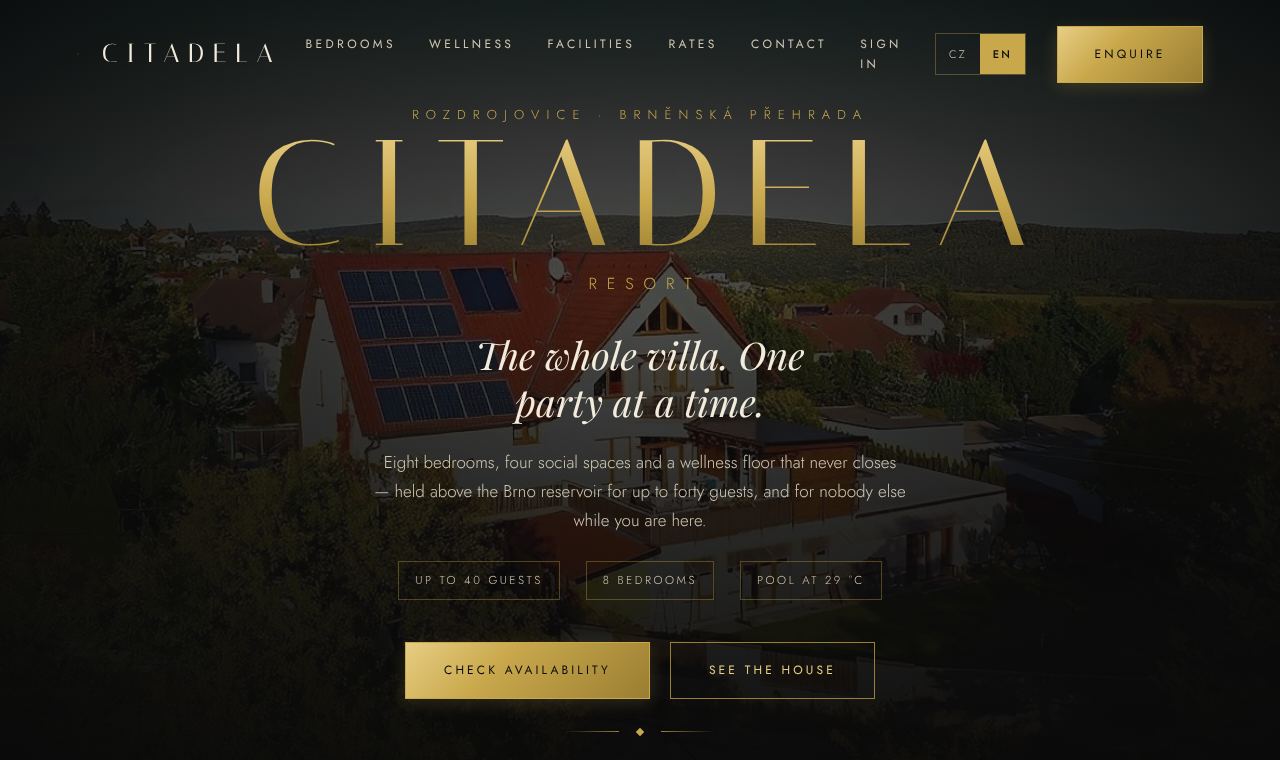
Citadela Resort is a villa with wellness above the Brno Reservoir in Rozdrojovice, let as a whole to one party at a time. I built its website and booking back end for the owner, a local accommodation business: the bilingual site, inquiries and administration, calendar sync with Booking.com, the brand identity, and the server side of NFC door access and scooter rental.
The brief
The owner had a striking art-deco page in a single HTML file and a Booking.com listing. The page was English-only, hard to use on a phone, nearly invisible to search engines, and its inquiry form sent nothing. Nothing stopped the same weekend being sold directly and on Booking.com at once, and the owner also wanted NFC door access and e-scooter rental, which need a back end that can be trusted with real doors.
Booking.com offers no public API to a property this size, and no "sign in with Booking.com" for guests. So the integration had to work with what is actually available: affiliate deep links and the iCal calendars the Extranet already imports and exports.
What I delivered
Presentation of the house, bedrooms, wellness and rates with cancellation terms, in Czech and English. Each language has its own URL with hreflang, so both are indexable and shareable.
The inquiry form writes to the database. Staff confirm or release inquiries in an admin area, and guests can sign in with Google to see their own requests.
Dates sold on Booking.com block the direct calendar, and directly confirmed stays are published back so Booking.com never resells them.
Designed and implemented the server side for room doors and e-scooter docks: signed reader requests, replay protection, fail-closed decisions and per-minute rental billing, exercised by a reader simulator in CI.
"Gold light on dark water": matte black and rich gold, Italiana for the logotype, Playfair Display and Jost, and a five-star concierge voice used across the site copy.
Production on Vercel with Neon Postgres and migrations applied on deploy. CI runs type check, unit tests and a production build, then boots the built server and runs signed-reader checks against it.
Selling each night once
Occupancy has two independent sources, Booking.com and direct stays, and every availability check reads both. Booking.com stays the source of truth for its own sales; direct stays are ours to add and release.
- 01 Booking.com Extranet Exports the property calendar as iCal
- 02 Inbound sync Scheduled job replaces the Booking.com snapshot
- 03 One availability check Booking.com and direct stays read together
- 04 Staff confirm Occupancy written in one transaction
- 05 Outbound feed Direct stays published back as iCal
Design decisions
The villa is never let by the room, so the data model has a single rentable unit. Capacity, bedrooms and rates live in one typed site file; the words live in the dictionaries.
Confirming an inquiry writes its nights and flips its status in one transaction, and a unique key on (unit, date, source) is what makes two simultaneous confirmations safe. Check-then-insert alone loses that race.
The English dictionary defines the type and the Czech one is declared against it, so a missing or extra key fails the build instead of shipping a blank label.
The iCal parser returns all-day dates as local midnight while night expansion works in UTC. On a UTC server nothing shows; in Brno every block shifted a day. Converting the calendar day to UTC explicitly fixed it, and a check script proves a confirmed date now answers a second inquiry with 409, not 201.
Doors are not a web form
The access layer opens real doors and starts paid scooter rentals, so it was built with the same habits as the safety-critical work on my CV: explicit invariants, pure decision logic, and evidence for every outcome.
- A card UID is not a secret. Authorization is always challenge–response: for cards the reader holds the key, for phones an Ed25519 signature covers a fresh challenge.
- Readers sign every request with Ed25519 and the server stores only public keys, so a database dump contains nothing that can open a door.
- Each request carries a nonce and a timestamp. A reused nonce or a clock more than a minute off is rejected and logged.
- Decisions are made by pure, database-free rules that are unit-tested on their own, and they fail closed.
- Every decision, allowed or denied, is written to an audit log. Those entries are personal data, so a scheduled job deletes them after a retention period.
- Money is stored in haléře, never as floating point.
Where it stands: the website, inquiries, administration and Booking.com sync are live. The access server and its CI checks are done; reader heartbeats, device provisioning with key rotation and an offline door credential come next, together with the hardware installation.